Tap water in your aquarium: what to know
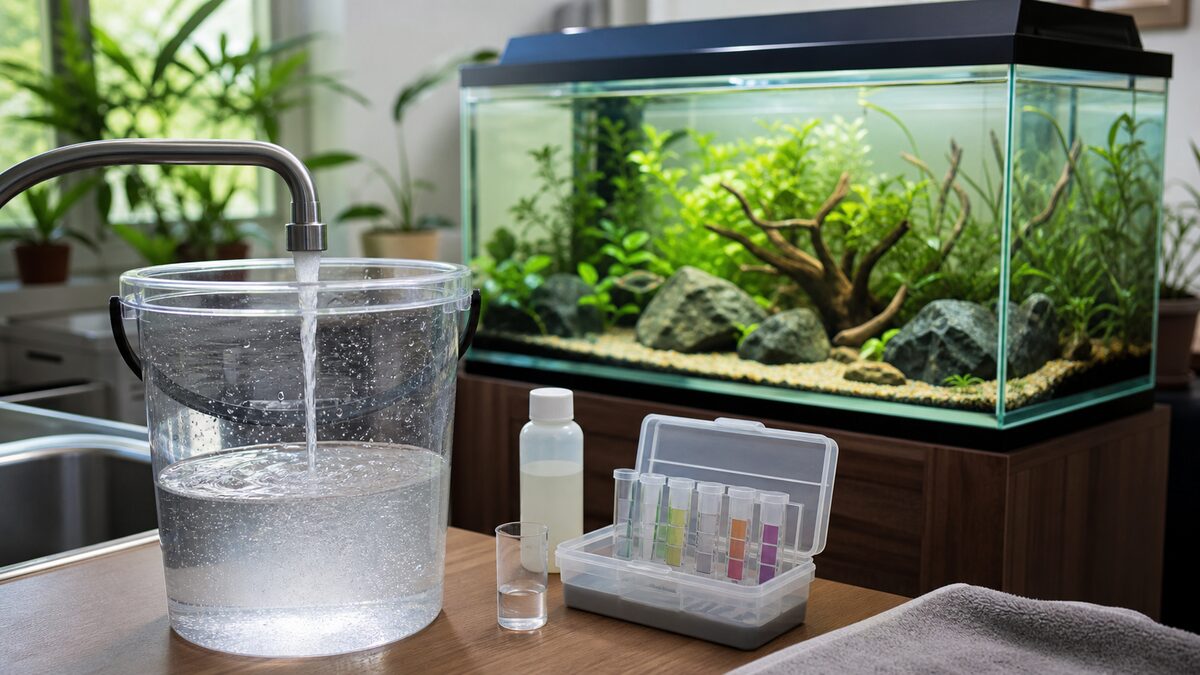
It’s the first question when you fill a tank: “can I use tap water?” Short answer: yes, in the vast majority of cases, but never as it is. There’s one essential step first. Here’s everything you need to know.
The short version. Tap water suits most freshwater tanks, as long as you neutralise the chlorine (and chloramine) with a water conditioner before adding it. These disinfectants, added to make the water safe to drink, are toxic to fish and kill the filter bacteria. The rest (hardness, pH) depends on your area and mostly guides your choice of species.
Chlorine: the invisible enemy
To make it safe to drink, tap water is disinfected with chlorine or chloramine. Great for us, disastrous for an aquarium:
- chlorine burns fish gills;
- it kills the filter bacteria, the ones that make the water liveable.
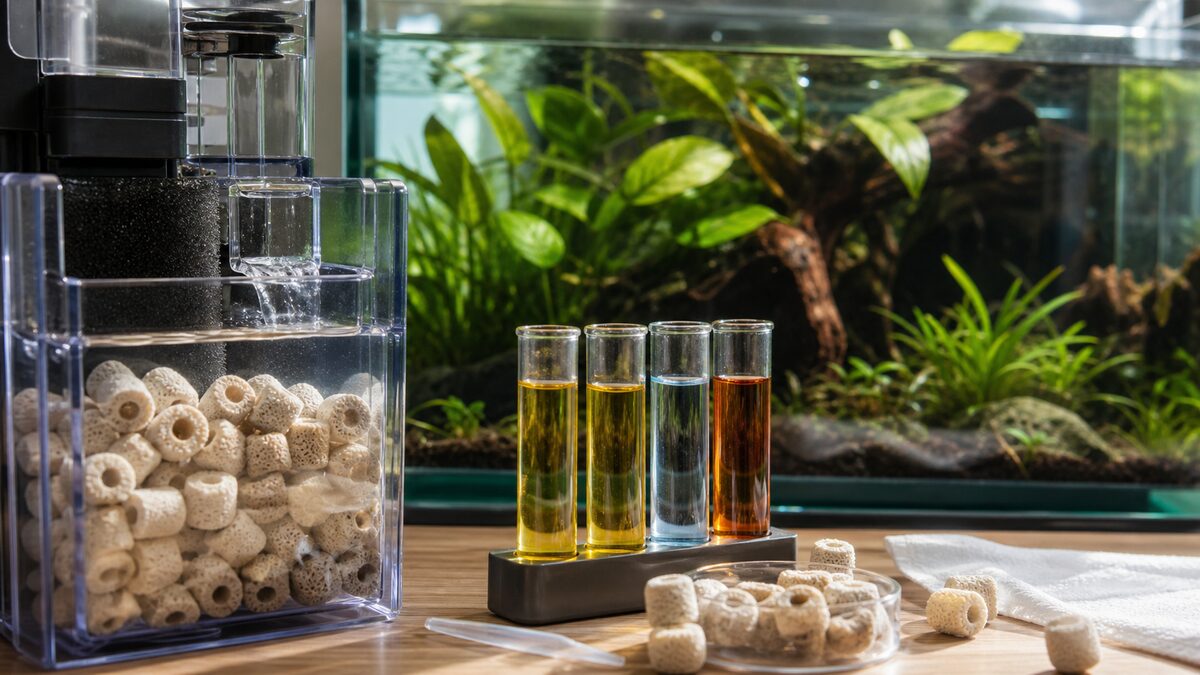
That’s why you never fill a tank straight from the tap without precautions, and never rinse your filter media under the tap.
A classic mistake I see all the time: rinsing the filter sponge under the tap "to clean it properly". That kills the bacterial colony. Always rinse filter media in a bucket of tank water, never under the tap.
The solution: water conditioner
Water conditioner (or “dechlorinator”) instantly neutralises chlorine and chloramine. It’s a basic product, cheap, and lasts a long time: a few drops per litre.
You use it every time you add tap water: the initial fill and every water change. The old advice to “let the water stand for 24h” is less reliable: it drives off plain chlorine but not chloramine, which is increasingly used.
A water conditioner is one of the very first things to buy. Here’s our pick:
Water conditioner (dechlorinator)
Our pick- Instantly neutralises chlorine and chloramine
- Also protects the filter bacteria
- Cheap and economical: a few drops per litre, one bottle lasts ages
Amazon affiliate link. Price and availability may change at any time.
To find out your hardness and pH, a test kit is the useful companion:
pH / GH / KH test kit
Our pick- Measures pH, GH and KH: enough to place your water (hard or soft)
- Helps you choose suitable species rather than altering the water
- More reliable than the water company's figures alone
Amazon affiliate link. Price and availability may change at any time.
Know your water: hardness and pH
Once the chlorine is sorted, tap water has characteristics specific to your area:
- Hardness (GH/KH): “hard” (limescale-rich) or “soft” water.
- pH: leaning alkaline in hard water, acidic in soft water.
Good news: you don’t need to change these values if you pick suitable fish. In hard water, guppies, platies and mollies are perfect. It’s only for demanding species (some shrimp, soft-water tetras) that you’d look to soften.
- I add a water conditioner EVERY time I add tap water
- I never rinse the filter under the tap (tank water only)
- I know my water's hardness/pH (test or water company figures)
- I choose fish suited to my water rather than altering it
- The top-up water is at the right temperature before adding
Conclusion
Yes, tap water is perfect for a freshwater tank, as long as you add a conditioner every time to neutralise the chlorine. Then learn your water’s hardness so you can choose the right fish. With that one simple dechlorinating habit, you’ve sorted 90% of the “which water” question.
If your water is very hard and you’re after shrimp, see « Hard tap water: how to soften it for your tank ». And for the full setup, « How long to cycle a 54L tank? ».
Frequently asked questions
Can you put tap water in an aquarium?
Yes, tap water suits most freshwater tanks, as long as you neutralise the chlorine (and chloramine) with a water conditioner before adding it. It's the most widely used water in the hobby.
Why do you need a water conditioner?
Tap water contains chlorine (or chloramine) added to make it safe to drink. These disinfectants are toxic to fish and kill the filter bacteria. A conditioner neutralises them instantly; it's an essential product.
Should you let tap water stand for 24h?
Letting it stand drives off some plain chlorine, but not chloramine (increasingly common). A water conditioner is more reliable and immediate. Nobody relies on a 24h stand alone any more.
Is tap water too hard for fish?
It depends on your area. Hard water suits guppies, platies and mollies perfectly well. For soft, acidic-water species (some shrimp, tetras) you sometimes need to soften it. You pick your fish to match your water's hardness.