What tank size is best for beginners?
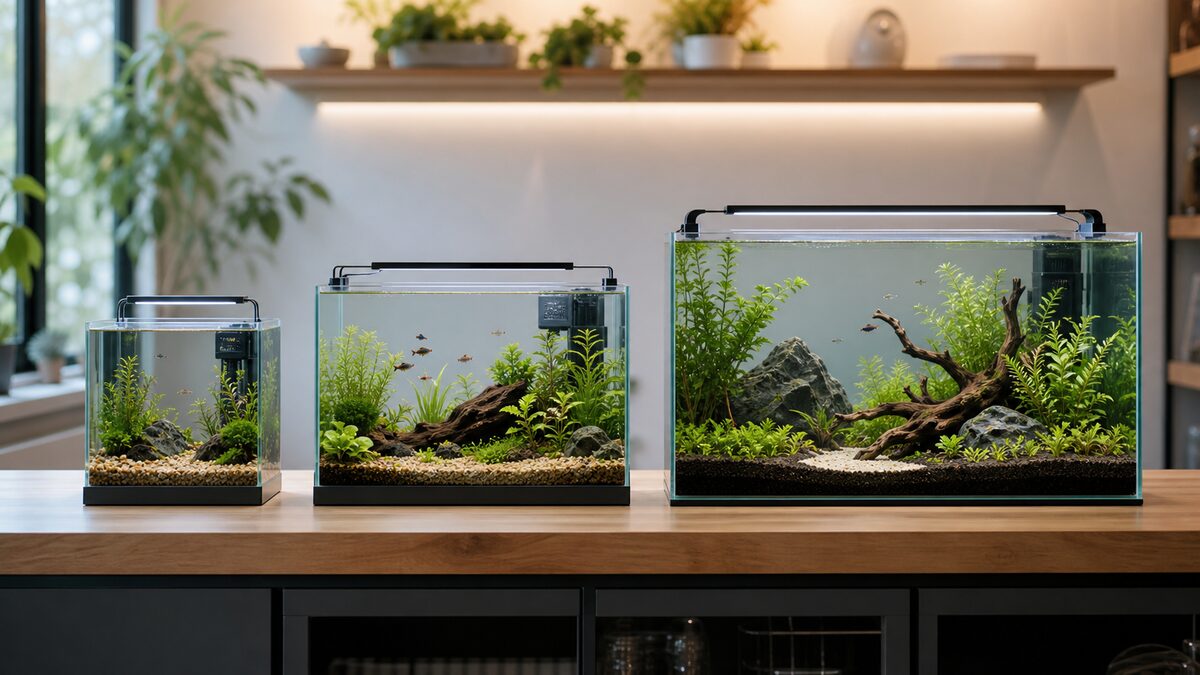
“I’m a beginner, I’ll get a small tank to start, it’s simpler.” It’s the most common gut-feeling mistake there is. In fishkeeping, a large volume is easier to manage than a small one. Here’s why, and what size to aim for with your first fish.
The short version — our pick. To start out, aim for 60 to 100 litres. A large volume is more stable (temperature, parameters) and forgives mistakes; a small tank goes off balance fast. Below 30 litres, everything speeds up, including the problems. You choose the volume based on the fish you want, never the other way round.
Why big = easy
The key is stability. The more water there is, the more time and the bigger a swing it takes for anything to go wrong:
- Temperature: a large volume takes longer to cool down or heat up → less stress.
- Parameters: an ammonia or nitrate spike is diluted in a big tank, whereas it quickly turns toxic in 20 litres.
- Mistakes: a handful too much food barely pollutes a 100L, but can poison a nano.
A small tank isn’t “a simplified aquarium”: it’s a more demanding one, that calls for round-the-clock consistency.
The biggest tank your space and budget allow will almost always be the right choice to start with. Nobody ever regrets going "too big"; people often regret going too small and having to buy everything again six months later.
The right volume for your plan
| Volume | Who / what for | Level |
|---|---|---|
| < 30 L (nano) | Shrimp, 1 betta, decor — rigorous maintenance | Demanding |
| 54–60 L | First tank, small group of easy fish | Ideal for beginners |
| 80–120 L | Community tank, several species | Ideal, very stable |
| > 120 L | More species, bigger fish | Easy to keep, heavier to kit out |
The volume follows from your fish: a single betta is happy in 20 L, but a school of zebra danios needs length to swim. Decide on the residents first, then the volume, not the other way round.
Think about weight and space too
A full tank is heavy: reckon on roughly the volume in litres plus the weight of the tank and decor (a 100 L easily weighs 120–130 kg). You need a proper stand and a floor that can take it. Plan for easy access for maintenance too.
For a simple start, a complete 60–100 L kit bundles tank, filter and lighting together. Here’s our pick:
Complete aquarium kit, 60–100 L
Our pick- Tank, filter and lighting together: nothing to pick separately
- A stable volume that forgives beginner mistakes
- Stays compact for a living room and affordable
Amazon affiliate link. Price and availability may change at any time.
Think too about a stand built for the weight of a full tank:
Aquarium stand / cabinet
Our pick- Built for the weight of a full tank, unlike ordinary furniture
- Sets the tank at a good height for maintenance
- Stores your kit (conditioner, tests, food) within easy reach
Amazon affiliate link. Price and availability may change at any time.
- I chose my fish BEFORE the volume
- I'm aiming for 60 to 100 L for a first tank
- I have a stand that supports the weight (a full tank is heavy)
- I've allowed space for maintenance and access to the back
- I know a nano needs more discipline, not less
The beginner's sweet spot is the 60-100 litre: big enough to be stable and forgiving, compact enough to fit a living room and stay affordable. It's the volume I'd recommend without hesitation for a first tank.
Conclusion
To start out, think big within the limits of your space: 60 to 100 litres give you the stability that makes fishkeeping easy. Choose your fish first, work out the volume from there, and get a solid stand. The tempting little nano is, in reality, a format for the experienced aquarist.
To choose the tank around the fish, see « Which tank for which fish? ». And once the tank is chosen, start its cycle properly.
Frequently asked questions
What size tank should a beginner start with?
A volume of 60 to 100 litres is ideal to start with. Counterintuitively, a big tank is easier to manage than a small one: the water is more stable and mistakes have fewer consequences. Below 30 litres, everything happens faster, including the problems.
Is a small tank easier for a beginner?
No, it's the opposite. A small volume goes off balance quickly: temperature and parameters swing at the slightest change, and an overfeeding slip can be fatal. A large volume dilutes mistakes and is far more forgiving.
How many litres for a few fish?
For a small group of easy fish (guppies, platies), a 54 to 60 litre tank is a good start. For slightly bigger fish or several species, aim for 80 to 120 litres. The volume always depends on the species, not the other way round.
Are nano tanks a bad idea for beginners?
Not banned, but more demanding. A nano (under 30 L) needs real consistency because the water goes off balance fast. It's a format best left to those happy to do rigorous maintenance, or to shrimp rather than fish.