Cloudy aquarium water: full guide
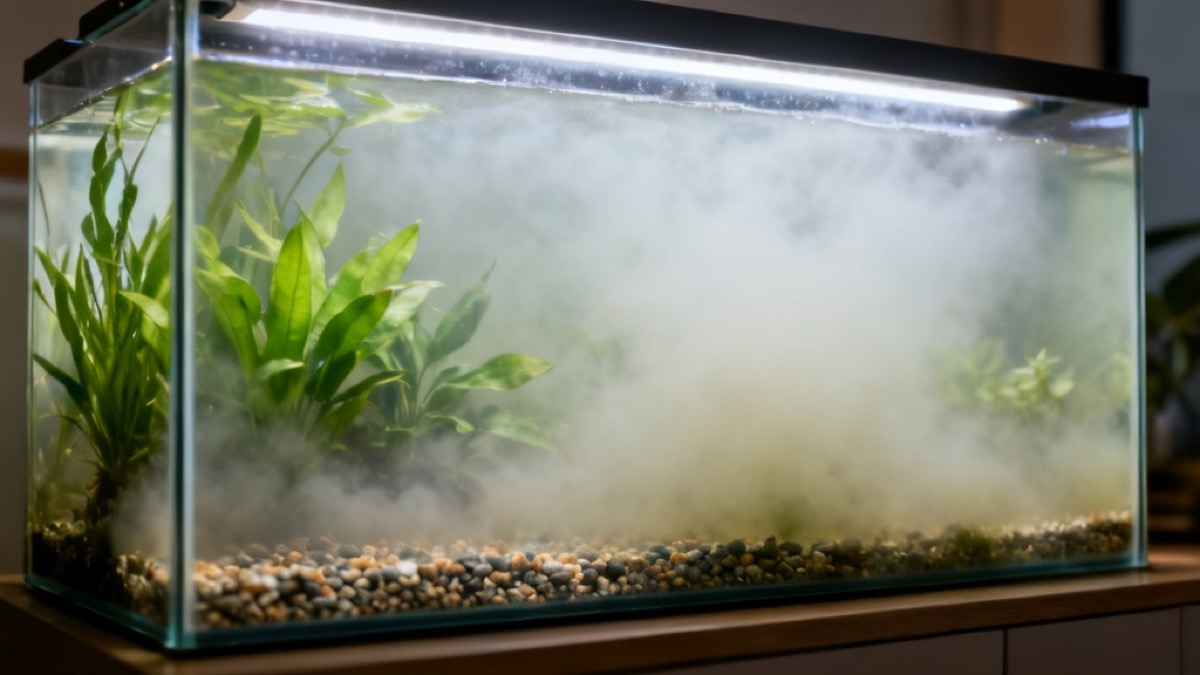
Your aquarium water has gone milky, grey or greenish overnight? Don’t panic: in the vast majority of cases it’s nothing serious, but you need to identify the colour and the context to apply the right fix. This guide runs through every cause of cloudy water and what to do about each one.
The essentials. White/milky water in a recent tank = a bacterial bloom, usually benign, that passes on its own within a few days. Green water = free-floating algae (too much light/nutrients). Brown water = tannins from wood (harmless) or particles. In almost every case: don’t change all the water, stop overfeeding, and let the filter do its work.
Step 1: what colour is the water?
The colour is your best clue. Identify yours:
| Colour | Most likely cause | Severity |
|---|---|---|
| White / milky / grey | Bacterial bloom or fine particles | Low (often temporary) |
| Green | Microscopic free-floating algae | Medium (looks bad + cause to fix) |
| Brown / tea | Tannins from wood, or substrate particles | Very low (often harmless) |
| Cloudy + strong smell | Excess organic matter, overfeeding | Fix it quickly |
White / milky water: the bacterial bloom
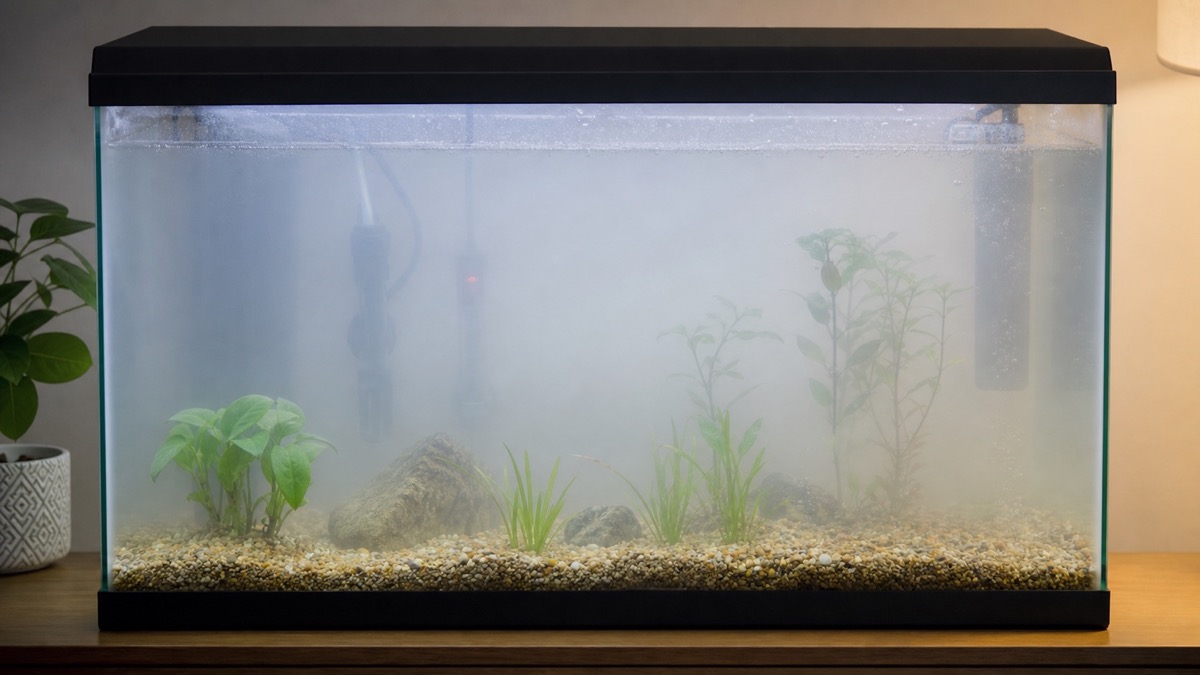
This is the most common case, especially in the first 2 to 4 weeks. The water clouds abruptly, like diluted milk.
Why? A population of bacteria explodes in water whose balance isn’t yet in place (typically during cycling, or after over-thorough cleaning that disturbed the filter’s colony).
What to do?
- Be patient. In a cycling tank, the water clears on its own within 2 to 10 days.
- Stop feeding for 1 to 2 days: fewer waste products, less fuel for the bacteria.
- Don’t do a big water change: it would delay things settling.
- Don’t rinse the filter thoroughly during this phase.
The worst reaction to milky water is wanting to "clean everything": a big water change, a scrubbed filter, a deeply vacuumed substrate. That's exactly what restarts the bacterial bloom. Often, the best thing you can do is nothing, and let the tank find its balance.
Green water: too much light and nutrients
Green water is a bloom of free-floating microscopic algae. It almost always comes from excess light (a tank near a window, lighting on too long) combined with excess nutrients (overfeeding, few plants).
What to do?
- Cut the lighting to 6–8 hours a day maximum, and move the tank away from direct light.
- Limit food and do regular partial water changes.
- Add fast-growing plants that compete with the algae.
- As a last resort, a UV steriliser removes the free-floating algae.
Brown water: often harmless
A “tea” tint usually comes from the tannins released by wood (roots, branches). It’s harmless — it’s even sought-after in “blackwater” tanks. To clear it: soak the wood before adding it, use activated carbon, or do water changes. If the colour comes from kicked-up substrate particles, it settles within a few hours with a good filter.
Before buying a "clarifier" product or a UV unit, give the tank 48–72 hrs. 8 times out of 10, the water clears on its own. Gear only makes sense for recurring green water.
The right move: test the water
Cloudy water in a recent tank is an invitation to check the cycle. If ammonia or nitrite are detectable, the tank isn’t cycled: that’s the root cause.
A liquid (drop) test kit will tell you in 5 minutes whether the cloudiness is hiding a cycle problem. It’s the diagnostic tool we recommend:
Liquid water test kit
Our pick- Measures ammonia and nitrite: the two indicators of an incomplete cycle
- Liquid drops are more reliable and longer-lasting than test strips
- Reusable across hundreds of tests
Amazon affiliate link. Price and availability may change at any time.
If the test rules out a cycle problem and it’s stubborn green water that keeps coming back, a UV steriliser sorts it out within a few days:
UV steriliser
Our pick- Clears free-floating algae within a few days
- Harmless to fish
- Only useful for recurring green water (not the bacterial bloom)
Amazon affiliate link. Price and availability may change at any time.
Before you sign off, run back through the right moves:
- I've identified the colour (white / green / brown)
- I've stopped overfeeding
- I have NOT done a big water change or scrubbed the filter
- I've tested ammonia and nitrite to rule out an incomplete cycle
- For green water: lighting cut to 6–8 hrs and tank moved away from the window
Conclusion
Cloudy water is alarming, but it’s rarely dangerous: above all it’s a message. Read the colour, rule out an incomplete cycle with a test, fix the cause (light, food) and — the hardest part — give the tank time to balance out.
For specific cases, see “Cloudy white water after setup: how long?” and our dedicated “Green aquarium water: full guide”. And if your tank is new, first make sure it’s properly cycled.
Frequently asked questions
Why is my aquarium water cloudy when it used to be clear?
Water that suddenly turns cloudy (milky) in the first few weeks is almost always a "bacterial bloom": an explosion of bacteria in water that hasn't settled yet. It's common and usually temporary — the water clears on its own within a few days if the tank is cycling.
How long does cloudy water last in a new tank?
Milky white water in a new tank usually lasts 2 to 10 days. If it persists beyond two weeks, look for overfeeding, an undersized filter, or over-aggressive cleaning that keeps restarting the cloudiness.
Should I change all the water when it's cloudy?
No, especially not in a new tank: a big water change delays things settling and can make the cloudiness worse. Prefer partial changes of 20–30%, stop feeding for 1–2 days, and let the filter do its work.
Is green water the same thing as white water?
No. White/grey water is bacterial or caused by particles in suspension. Green water is a bloom of microscopic algae, linked to excess light and nutrients. The causes and the fixes are different.